Experience of time in digitally-mediated spaces
By Angelica Ruzanova
The ancient Mayans were considered master observers of the sky.
The constellations, rituals, and mathematics came together to create an intricate system of management and symbolism, of organization and belief. While to us watches may seem as garments that count our daily steps or sought-for decorative antiques, early timekeeping strategies were an instrument of survival and navigation, technologies that made time legible enough to coordinate harvests for food and, by association, cosmic sense-making.
That’s why when the Long Count Calendar, lasting 1,872,000 days or 5,125.366 tropical years, ended on December 21, 2012, people thought it marked the end of the world.
But it wasn’t so. Instead, the world underwhelmingly continued functioning, the seconds unabashedly ticking forward. Or maybe, the feeling of time ending, the collective expression of a symbolic end of time, isn’t so far fetched.
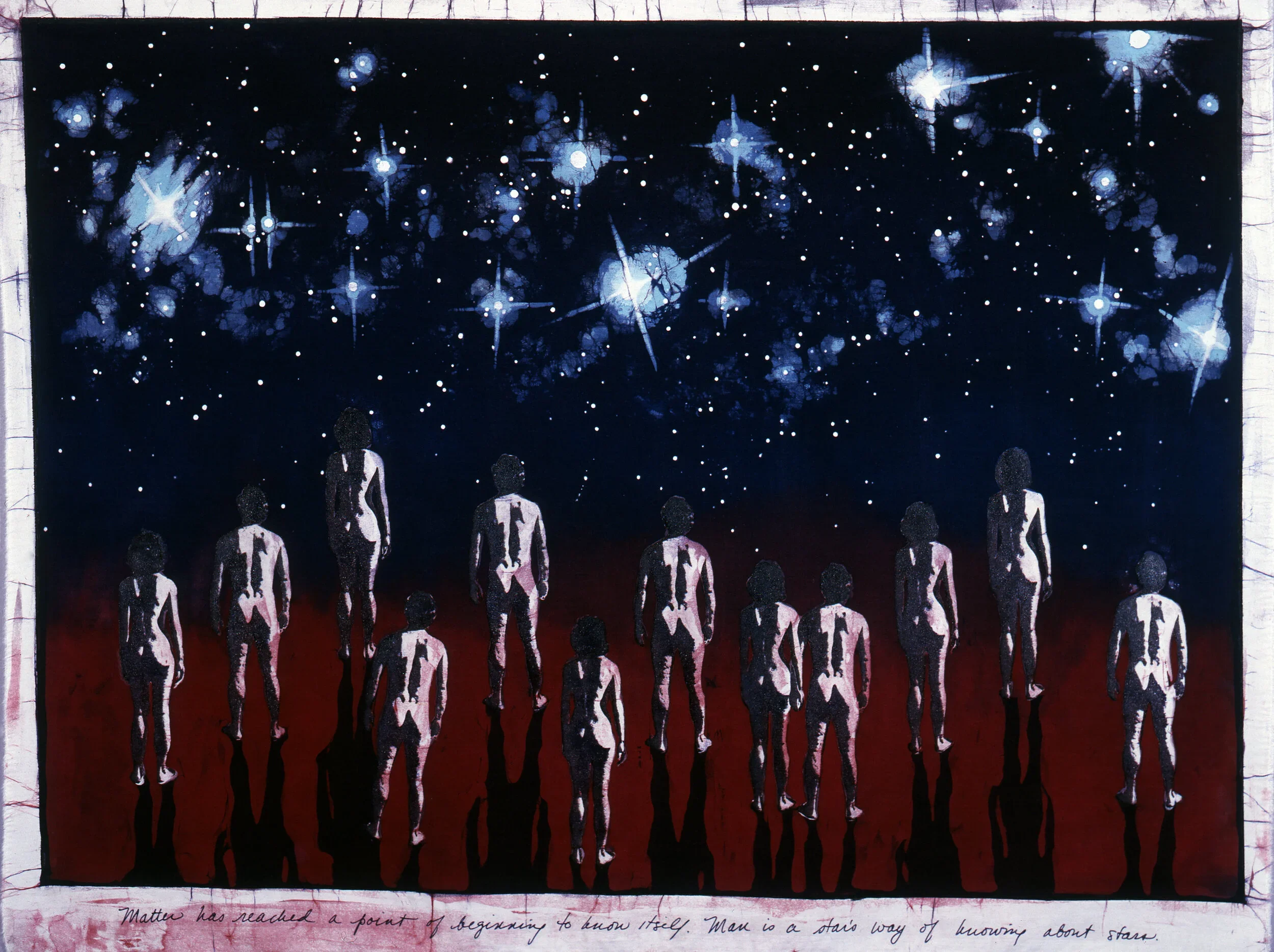
I first saw “A Star’s Way” in the Smithsonian's National Air and Space Museum in Washington D.C. Angela Manno, the artist, used ancient dying techniques and modern technology to explore the connection between humanity and cosmos. I felt an instant connection to the piece itself, exploring the idea of consciousness in a developing world.
In Mark Fisher’s notorious 2014 lecture, “The Slow Cancellation of the Future,” the writer discusses a technology-led temporal pathology in which time, both historically and phenomenologically, is suppressed by “urgencies” and “communicative capitalism.” More simply, Fisher points to the fact that with the ease of accessing content online, timelines become blended together beyond distinction.
Retro music popular in the 80s, for instance, becomes less a self-defining style than an algorithmic arrangement, a recurring aesthetic for a culture that reprocesses itself because the archive is frictionless and ever-present. “The sense of culture belonging to a specific moment - that is what has disappeared in the 21st century,” Fisher said in the lecture.
Advanced technology mediated by the Internet, such as social media, chatbots, and other smart gadgets, are humanity’s next attempt to connect the external, collectively-experienced world to the individual. With artificial intelligence (AI), a deep-learning software that now competes with trained professionals on standardized tasks, the temporal existence of society takes a different shape and form.
If in the twentieth century society optimized mass production of goods, in the twenty-first we are streamlining the mass-production of knowledge. Legally, many questions regarding reorganization of time emerge. It is often regulators, platforms, and cross-border policy bargaining that decide whose time is protected and whose is harvested. Socioculturally, emerging behaviors may help us recourse maladaptive use of such technology, and gaining conceptual clarity is the first step.
I am in Tokyo, Japan, aloof with thoughts and dazed with inspiration in a city that perfectly blends the cornerstones of history and contemporary life. Much research is needed to track down the perception of time throughout human history. But maybe my journey will give me isolated clues to what this invisible force looks like today.
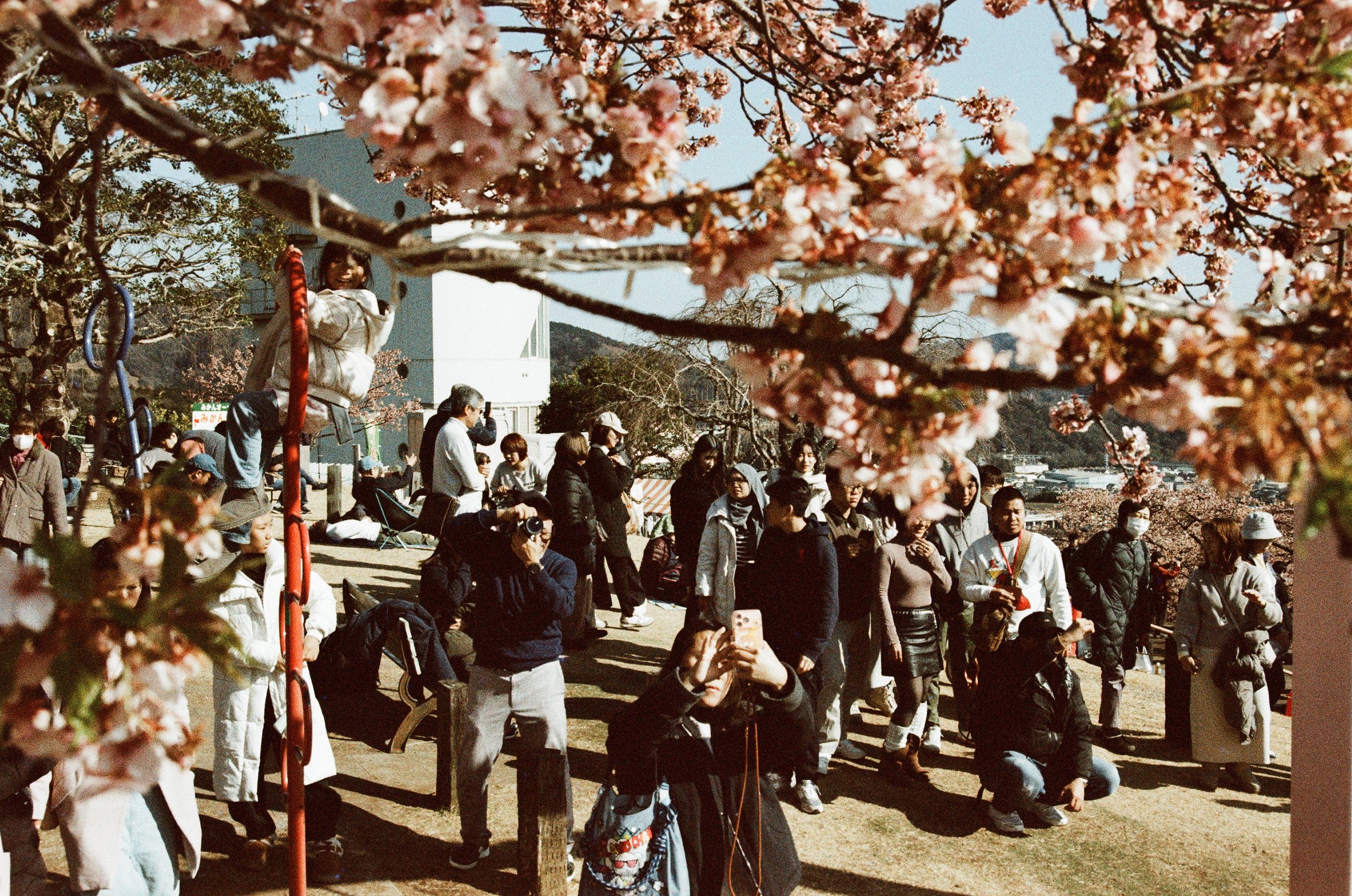
Observer-photographers gathered at the Matsuda plum blossom festival that overlooks Mount Fuji. In the digital age, every person embraces the role of a creator, with instant access to capturing, publicizing, and contributing to the moment. Photo by Angelica Ruzanova.
The disproportion of presence
Protruding, valiant skyscrapers rejoice with advertisements. In my recent read of Historian Yuval Noah Harari’s “Homo Deus: A Brief History of Tomorrow,” the parallel between organisms and algorithms is ever more apparent, ever more destined. Humans in the twenty-first century aren’t merely attempting to build artificial life, replicated from the circumstances that shaped our own; we are becoming part of it, defying adaptation by the law of natural selection.
“The organism that survives and reproduces gets to leave a footprint of their descendants,” or so the story goes. Bioengineered genes and cybernetic limbs are now part of evolutionary story, except with each step forward humanity is slowly readjusted, erased and programmed anew. With the editing of the human body, our schedules likewise shift. Retirement age, parental leave, work-hour directives, and the shrinking or expansion of what a society calls “free time” adapt step-in-step with what our bodies are physically capable of.
The prolongation of human life (74 years in 2023 globally, discounting the uneven distribution) amid the backdrop of a large chunk of it spent online (more than 6 hours on a daily average in 2024) takes the following effect: we live much longer, but experience less.
The average age at which children receive their first phone is about 12 years old. Subtracting the years before access to a digital device and calculating the proportion that we spend plugged in for the rest of it, 23% comes out as an imprecise calculation. If almost a quarter of our life is spent receiving new information at an unparalleled pace, how much we can consume escalates, not how much we live and practice, blinded by the promise of outlier appearance, health, and agility on social media.
In his 1998 book “The Information Bomb,” French philosopher Paul Virilio characterized the idea of disproportionate presence within the backdrop of cyber warfare. Real-time events documented through instant media globalization, he said, serves as a "disorientation of our relation to reality." With evolving information technology, weaponization of media shifts, too, and such “virtualization of action” is bound to impede on the conscious ability to exercise presence.
Immortality, bliss, and divinity. At the traditional shrines of Tokyo, I ask myself: what meaning does “healing” hold in a world that optimizes health for upgrades?
“An economy built on everlasting growth needs endless projects,” Harari states, and that claim loudly announces itself on billboards for weight-loss pills and hair transplant treatment. Yet health in traditional Japanese medicine (Kampo 漢方) is an ephemeral state, comprised of balance and harmony with bodily functions and emotional stability. Here, the objective and subjective states perform a dance, a dance unlike any algorithmic equation, grounding presence in physical reality.
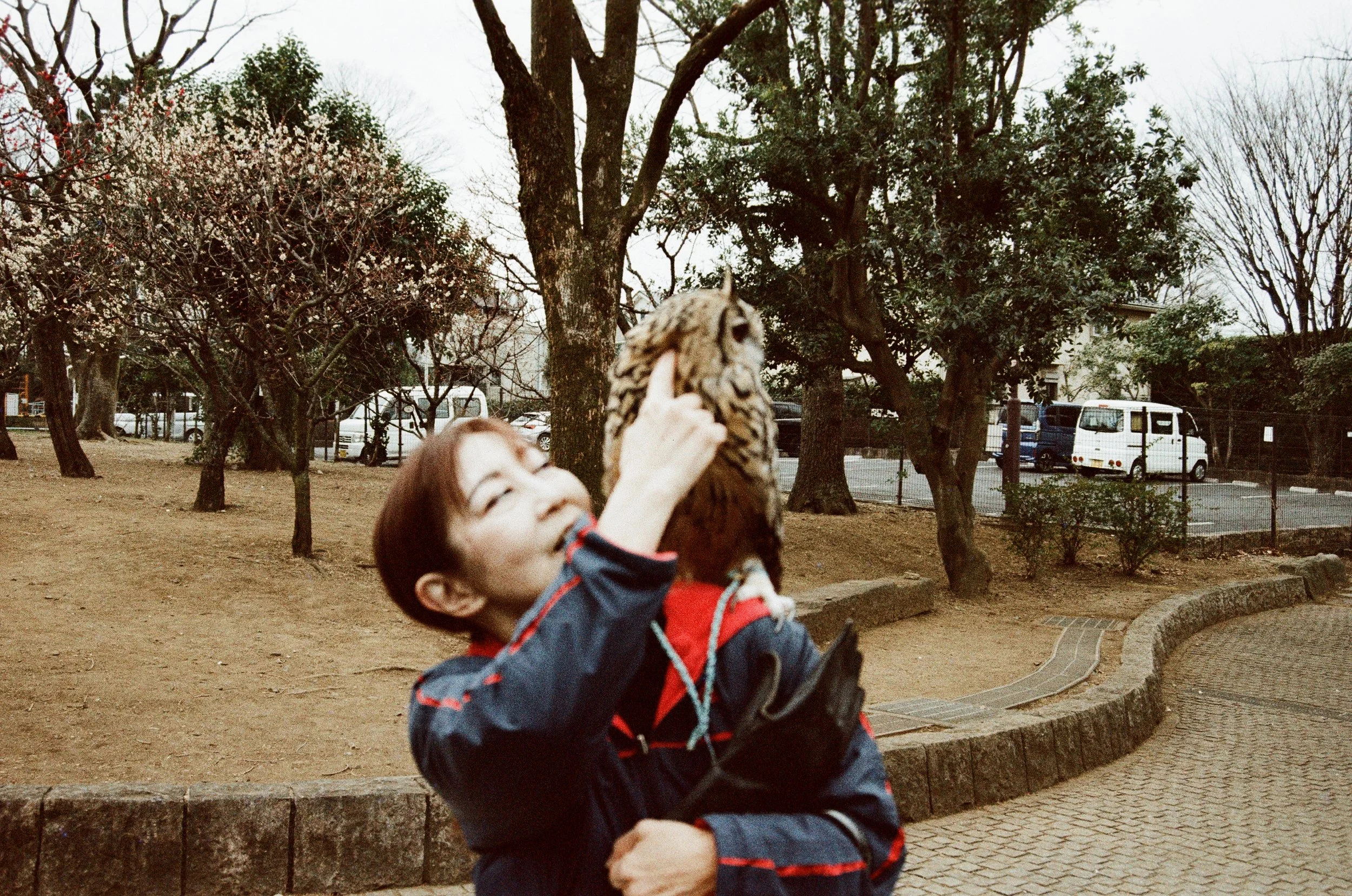
A lady taking her domesticated owl on an evening walk in Hanegi park. “He’s calm now,” she said. “It’s different when we’re at home.” Photo by Angelica Ruzanova.
The disappearance of originality
AI has often been coined a “regurgitation machine” as it spews summaries upon summaries across user interfaces and websites. The summaries, of course, are not based on critical thought, but on probabilistic output as a result of data training, resulting in an inherent detachment from context.
At the Center of News, Technology & Innovation this fall, I thought long and hard about the newfound role of journalists in our world; what value does a reporter bring in comparison with a round-the-clock, personalized device that appeals to a reader of any level?
Context is one unabated aspect of reporting, embedding real-world happenings at a scale ranging from local to global. Voice is another, trained not by data labeling and algorithm, but by a stream of consciousness Harari defines as “thoughts, feelings and emotions.”
Humans long for one another. The ease and speed with which a ChatGPT query satisfies one’s request, avoiding unnecessary awkward encounters, sometimes saving users’ money as a replacement for a service, is difficult to complete with. We are thus hit with more summaries, recycled content, and generated work that embodies already existing acts of creation.
Rising demand for faster content consumption outpaces the time to create something new, something that takes effort and collaboration. In turn, our use of emerging tools molds a culture of soft plagiarism that does little to differentiate one project, one living perspective that defines contemporary life, from another.
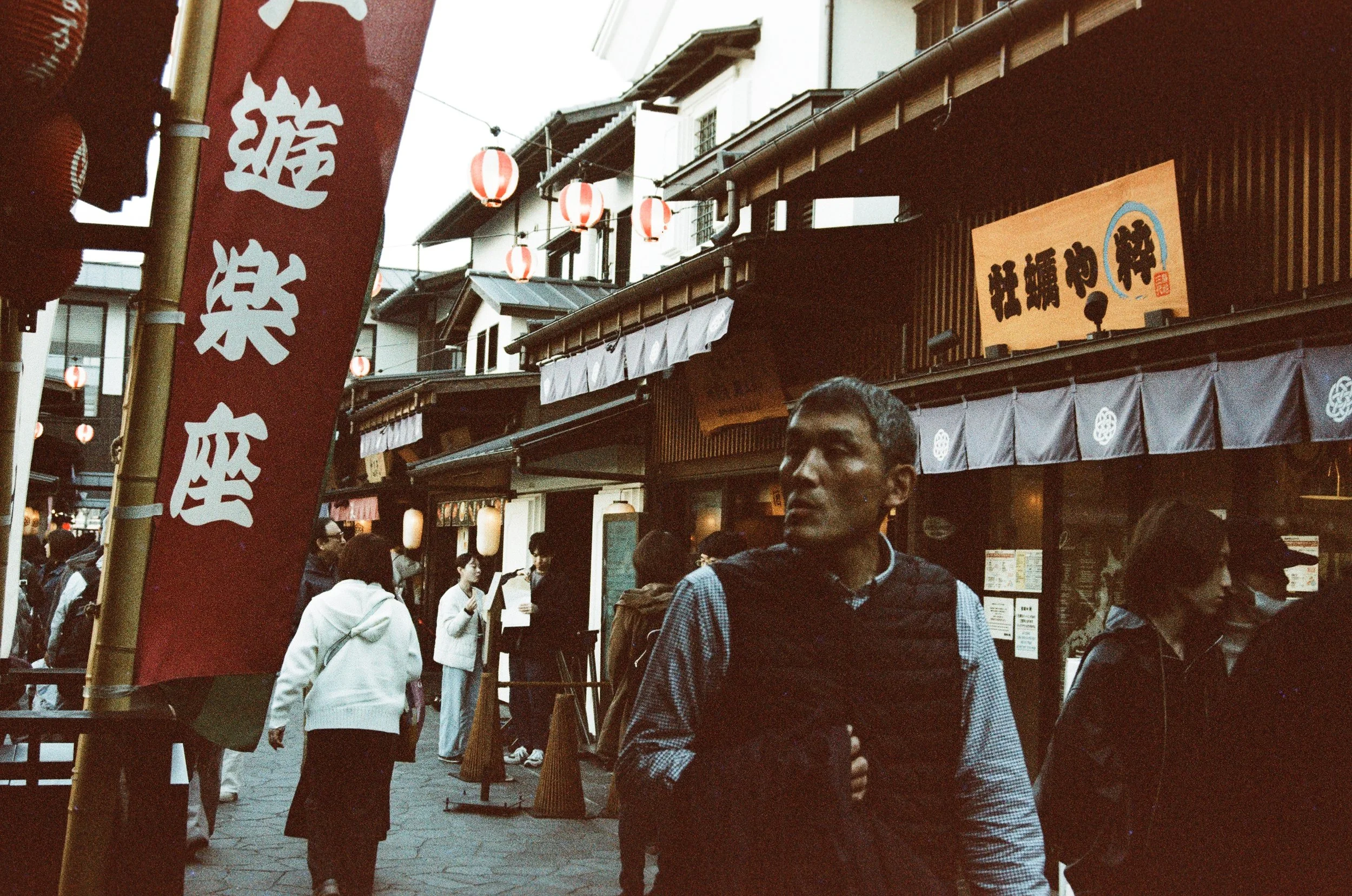
Matcha, one of Japan’s defining drinks, has recently been absorbed into social media’s “performative” repertoire. Once reserved for tea ceremonies and other formal settings, it is now an unmistakable example of globalization. Photo by Angelica Ruzanova.
The enlargement of productivity
According to Oxford Brittanica, one of the most cited dictionaries in the world, “time” is the most used noun in the English language. And by a far margin. What does that say about our priorities, our way of life in the English-speaking world?
I remember exactly where I was on December 21, 2012, at the ripe age of 9. I was walking home from my public school in Tashkent, Uzbekistan, making my solo daily expedition between the melting snow. I remember that year vividly, filled with gymnastics classes and poem-learning to the brim, and look back at it as a formative time spent surrounded by loved ones. Now, engulfed with branding and memories of others via algorithms, it may be that even the cognitive function of memory, abrased by an evermore shrinking attention span, is transformed.
To make my last point easier to absorb, I’ll list a number of things: 9-to-5, semester, PTO, deadline, clock-out. What do these all have in common? They are orienteers of time built for a lifestyle of productivity, and that is exactly what makes our world function like a well-oiled machine.
Some languages, whether outright lacking vocabulary to describe the end of a shift or perceiving time vertically rather than horizontally, showcase the interplay between time and behavior as a cultural phenomena. The crunching of time in the corporate world, for example, neatly structures it as a tool of precision, attributed in quarterly goals as a metric of optimization and efficiency.
“Science can be a language of distance which reduces a being to its working parts” Robin Wall Kimmerer observed in “Braiding Sweetgrass,” in which she collides scientific knowledge with Indigenous lessons of botany that allowed populations to thrive in harmony with their environment for centuries. “It is a language of objects.”
An uninterrupted waterfall crushes solemnly down a carved downstream of rock, eroding its sediments but feeding the natural pool below. Despite the aforementioned economic drivers that speed up our ability to exercise presence, originality, and meaningful thought, I stay believing that time does not bend to natural forces. But our accelerated experience of it might change our relationship to ourselves, our surroundings, and our vocations, unless we make an effort to pause and ask who this is for.